

















One front door, not five inboxes.
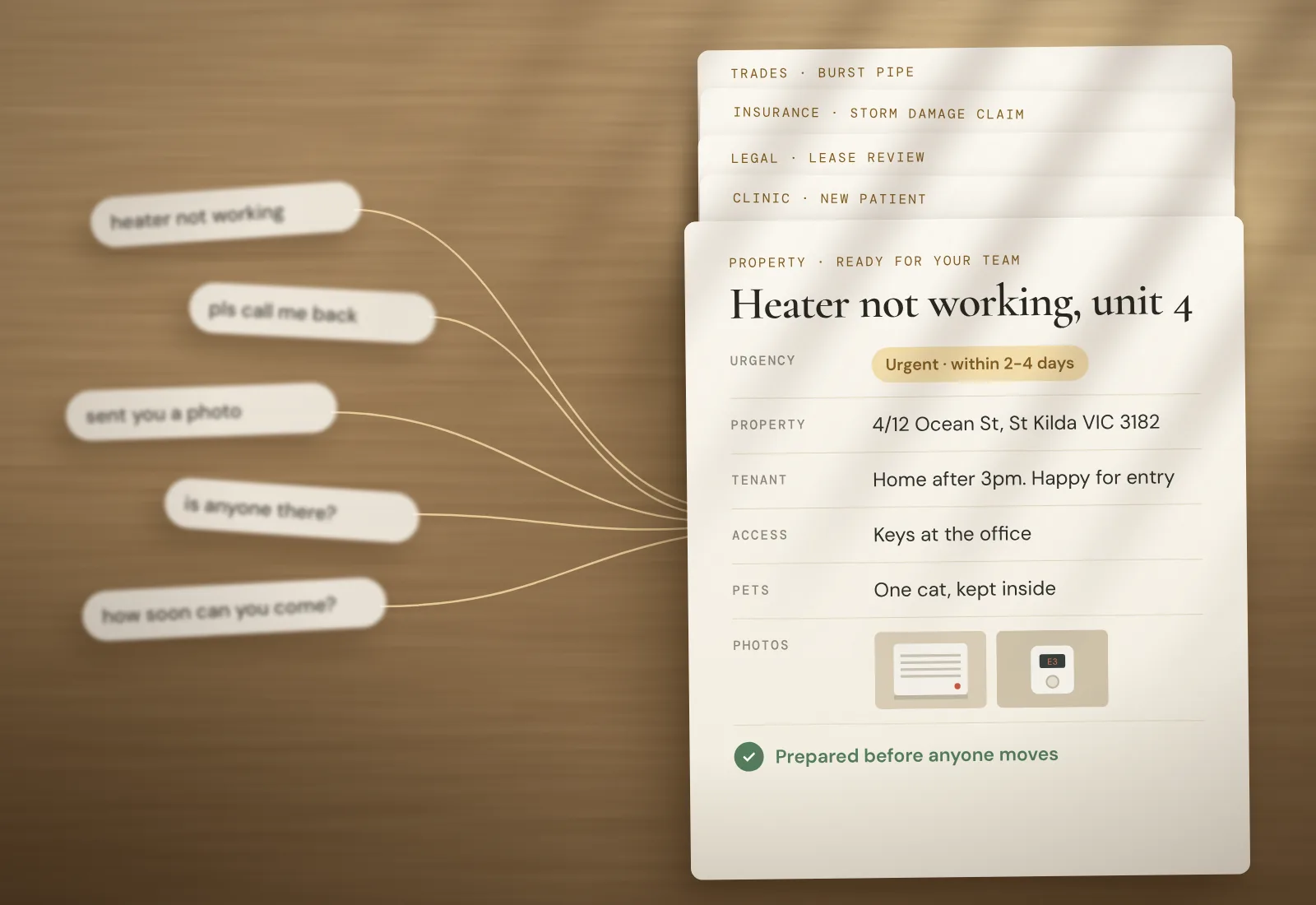
Customer conversations no longer need to be rebuilt by hand from scattered notifications. The office sees one prepared story with the next move already clear.
Hermia is a multi-channel enquiry intelligence system for trade contractors. It brings existing customer enquiries from Email, WhatsApp, Instagram, Facebook, and Google Business into one controlled qualification journey—then gives your office and technicians a prepared next move instead of a half-finished conversation.
Hermia brings existing enquiries from the channels your customers already use into one controlled conversation. It identifies the real customer, asks the right trade-specific questions, gathers the detail your team needs, and keeps the story moving until the next step is actually useful.
Every channel.
One controlled front door.
Not a lead generator. Not a generic reply tool. Hermia is a majestic AI operating system that turns every existing customer signal into one clear job story—without making your office chase the same detail across separate platforms.
Customers choose the channel. Your business keeps the standard. Hermia carries the conversation through the same trade-specific checks, so the important information arrives together rather than scattered through five different places.
Customer conversations no longer need to be rebuilt by hand from scattered notifications. The office sees one prepared story with the next move already clear.
The technician receives the problem, site, access, urgency, evidence, and customer context together—so the first call or visit starts prepared.
Customers receive a prompt, professional response without needing to change platform, repeat themselves, or wonder if their enquiry has been seen.
Most generic chat tools respond to a question and stop. Hermia takes responsibility for the first conversation until the business has enough real context to decide what should happen next.
Whether an enquiry arrives through Airtasker, Hipages, TaskRabbit, a referral, a web form, email, WhatsApp, Instagram, Facebook, Google Business, or a direct message, Hermia identifies the person who needs help and turns the incoming alert into a trade-ready job brief—not a generic script borrowed from another industry.
Hermia does not replace a technician’s on-site judgement, final quote, safety assessment, or licensed work. It prepares the context so the qualified professional can make those decisions with a clearer starting point.
The point in one sentence: Hermia does not hand your team a vague message; it keeps asking for the useful detail until the next person has a real starting point.
It does not pass a half-finished exchange to the office or the field team simply because the customer has sent a first message.
Hermia does not simply send an automatic reply. It holds the early conversation to a clear trade standard, then gives the office and field team the detail they need to decide what should happen next.
Whether the message starts on a marketplace, a form, social media, email, or a referral, Hermia keeps it with the customer and the same job story.
Hermia gathers the problem, site, access, urgency, evidence, timing, and trade-specific detail without filling in answers on the customer’s behalf.
The result is a prepared job brief for the business to act on, including private email dockets for Configuration Journey where that flow is configured.
The important boundary: Hermia prepares the information. A qualified technician remains responsible for the on-site assessment, safety decisions, final quote, and licensed work.
Every stage exists for one reason: by the time the work reaches your team, they know what the problem is, where it is, who is responsible, whether they can get in, what to bring, and what needs to happen next.
Real work can be hidden inside a platform notification, a forwarded email, a property manager’s message, a web form, or a direct chat.
Hermia recognises the genuine request for help and keeps the customer’s details connected to it. Marketing, receipts, supplier noise, and irrelevant messages do not get treated like jobs just because they landed in the same inbox.
Outcome / a cleaner front doorCustomers do not write like technicians. They explain the problem in their own words, often messy, incomplete, or emotional.
Hermia establishes what is actually wrong and what is affected. A leak, blockage, hot-water issue, burst pipe, switchboard fault, roof problem, alarm issue, or remedial defect becomes a clear professional summary your team can understand quickly.
Outcome / a clearer starting pointA job should not quietly land in the wrong suburb, state, country, or outside the business’s actual service area.
Hermia gathers and confirms the complete site context: full address, suburb, state, country, building type, and the information that makes the location actionable. It is more than a street line because the technician is the one travelling there.
Outcome / a real site, not a vague locationGetting to the address is not the same as being able to attend the work safely and professionally.
Hermia asks about access and conditions before arrival: whether somebody will be home, if a property is locked or restricted, whether a key, code, gate, reception sign-in, or induction is needed, and whether there are hazards or conditions the crew should know about.
Outcome / fewer surprises at the doorDifferent trades have different readiness questions. A generic checklist cannot tell a technician what they truly need to know.
Hermia follows the questions that matter for the job: water or gas isolation for plumbing, switchboard isolation for electrical, safe roof access for roofing, site restrictions for remedial work, or monitoring and notification context for fire and essential-safety work.
Outcome / preparation that fits the trade“Sometime this week” is not a plan. Neither is leaving the office to discover who pays, what is supplied, or whether a customer is comfortable proceeding.
Hermia records a clear preferred time, materials position, residential or commercial context, billing contact, and estimate context. Timing is shaped around the business’s real capacity, so the operation is not making promises that create a conflict later. Where the business provides an estimate, Hermia can present it clearly; if the customer needs a commercial discussion, it brings your team into that decision rather than guessing on their behalf.
Outcome / a next move the operation can useA vague answer is not the same as useful information, and a non-answer should not become an assumption.
When the customer is unclear, Hermia asks again in plain language. Photos and video remain tied to the same story. Repeat contact does not automatically create another loose record. The handover stays grounded in the detail the customer actually provided.
Outcome / less rework, less chasingHermia uses the information your business already relies on. Your custom fields are not a technical extra; they are the way the system learns what “prepared” means for your operation.
The fault, affected asset, customer description, urgency, defect status, and any brand or model detail the customer has provided.
The complete location, building type, commercial or residential setting, site contact, and context that helps the team plan a real visit.
Access arrangements, keys, codes, locked or restricted areas, inductions, hazards, isolations, and the conditions that affect a safe arrival.
Photos and video remain with the job context, so the team can see the issue rather than relying only on a written description.
Clear timing, customer availability, materials already supplied or still needed, and the information that makes a practical next move possible.
Billing contact, property manager or owner context, estimate expectations, and the commercial detail that prevents an awkward conversation later.
For one contractor, the most important fields may be asset type, fault code, defect flag, and building type. For another, it may be access notes, water or gas isolation, roof conditions, materials position, billing entity, or estimate amount. Hermia uses those fields to guide the conversation, so the final brief reflects the standards your business already works to—not a generic checklist.
Hermia is designed for the operating reality of the trade. It does not pretend that the questions for a blocked drain should be the same as the questions for a fire panel or a roof at height.
Issue and affected fixture, water or gas context, urgency, site access, and the detail that helps a plumber understand the practical work ahead.
Equipment or circuit context, fault detail, site access, safe isolation requirements, and conditions the electrician needs to know before attending.
Roof condition, access, safe ladder or scaffold context, weather-related considerations, photos, and a clear picture of the affected area.
Building context, defect description, site restrictions, property-management requirements, access, materials, and evidence of the issue.
System or asset detail, site and building context, isolation status, monitoring or notification requirements, and the coordination needed before work begins.
Hermia is designed to improve the first move for the people who carry the work: the technician, the operation, and the customer whose problem needs a professional response.
Technicians do not need another notification. They need a useful picture before they leave the yard. Hermia brings the job story together so the first ten minutes on site can start with context instead of reconstruction.
Hermia gives the office a calmer way to handle demand. Real enquiries are clarified, obvious noise is filtered, repeat contact is recognised, and the next person receives a handover that is complete enough to move with confidence.
They receive a prompt professional response, are asked sensible questions in plain language, and do not have to repeat their story to several people. Their timing, property, and problem are treated with care from the first message. When they return later, the relationship can continue with recognition rather than starting from zero.
Hermia is not here to make a trade business feel automated. It is here to make the business feel more prepared, responsive, and dependable at the moments customers and teams remember.
A vague enquiry should not become a vague job. Missing detail is handled early so the next person is not left guessing what they are walking into.
Access, hazards, isolations, site conditions, and visual evidence are treated as part of the handover—not an afterthought.
Hermia works behind the contractor’s business, helping the customer experience the same fast, considered standard under the company they chose.
Past customers should not have to begin from scratch. Good operational memory helps the business carry trust forward into the next job.
Your people keep the craft. Hermia keeps the detail moving—so customers feel heard, the office stays in control, and the field arrives with a better picture of the work ahead.
The difference between Hermia and a generic assistant is not how well it writes. It is what the system is allowed to decide—and what it is never allowed to guess.
Before a response is sent, the customer’s answer is assessed against fixed checks for that exact question and that exact trade. Does the address include the detail needed to reach the site? Does “pipe” identify which pipe? Does “power” identify which circuit? Does the fault description give a crew something real to act on?
The same input receives the same verdict every time—late at night, during a busy period, or on the ten-thousandth job. Hermia’s language is warm and human, but the decision about whether an answer is complete does not drift with the wording of the conversation.
That separation matters: Hermia uses its intelligence to explain the next question clearly, not to invent an answer or quietly waive a standard.
Every customer response moves through the same practical sequence before it becomes part of a job brief.
Where an estimate applies, Hermia starts with the pricing PDF or approved price list your business provides. It then considers the affected asset type and the fault detail the customer has actually supplied to find the closest supported estimate. It remains an estimate, never a final price. If the available pricing or job detail does not support a confident match, it is surfaced to your team instead of guessed.
A useful answer is not pushed back because the language is informal. The standard is about whether the detail is workable—not whether the customer speaks like a technician.
Nothing is inferred, guessed, or filled in on the customer’s behalf. If it was not said or shown, it does not become part of the job story.
Vague answers are followed up with clear options that make it easy for the customer to respond. The job does not move forward as if uncertainty were detail.
When a price, job, or customer answer cannot be handled with confidence, it is surfaced for the business rather than quietly turned into an assumption.
If a later message introduces emergency, urgent, or critical language, the conversation receives fresh attention instead of remaining closed while a genuine change waits.
Speed matters because customers stop shopping around when they receive a clear professional response. The timing is deliberate: fast enough to maintain momentum, measured enough to collect a complete answer.
First reply to a brand-new enquiry. Day or night, the first response is designed to arrive before a customer has time to move on to the next contractor—not the next business morning.
ONCE THE CONVERSATION IS UNDERWAY — RESPONSE WINDOW BY QUESTION TYPE
These windows are deliberate, not a delay. A customer may send an answer across several messages, then add a photo or a video. Hermia gives the reply enough room to arrive as one useful piece of context—without making the customer wait longer than necessary.
Hermia is designed as the operating layer between a customer signal and a technician’s next move. It brings the detail together before that detail has a chance to become another loose task for the office.
Hermia is the live operating layer between an incoming signal and the field-service workflow. It catches the request, reads the context, understands the evidence, and carries the prepared job story into the system your team already uses.
MULTI-CHANNEL ENQUIRIES
FIELD-SERVICE AUTOMATION
Hermia reads the relevant customer, site, job, custom-field, and team context needed for the next move—then carries the prepared information into the workflow without making the office retype the same story.
Hermia prepares the customer, site, job, evidence, and qualification context for the AroFlo workflow so the operation can move from an enquiry to a useful record with far less double handling.
Messages, email notifications, contact details, site information, photos, video, and supporting attachments are brought into the same operating picture.
A photo or a messy customer explanation is not left as a loose attachment. It becomes part of the problem, site, and trade-specific preparation story.
Simpro and AroFlo automation gives Hermia the relevant customer, site, job, custom-field, and capacity context needed to keep the next step grounded.
The customer gets a professional response, the office avoids double entry, and the field receives a cleaner handover with the important details already together.
Explore the complete Hermia experience from the beginning, including how existing enquiries become clear, ready-to-act job context.
Back to Home