
















About Hermia

It was never about the leads. It was about knowing the job first.

Hermia stands between your customers and your team. It replies within about a minute, asks the questions your business would ask, checks every answer, and hands your team work that is ready to act on. Add Hermia Automate and it keeps your CRM up to date too, without anyone typing it in. Nobody chases, nobody guesses, nobody retypes.

Why we do what we do

Good work starts with the whole story.

Read what Hermia says

Every job starts with a few words. A leak in the kitchen. Can I book in? I want to make a claim.

Then someone has to chase the rest: where, how urgent, who’s involved. That’s where I come in. Hi, I’m Hermia.

I answer every new enquiry in about a minute, day or night, in your business’s name, on WhatsApp or by email.

I ask your questions one at a time, and check every answer. Too vague? I ask again. Photos get checked too.

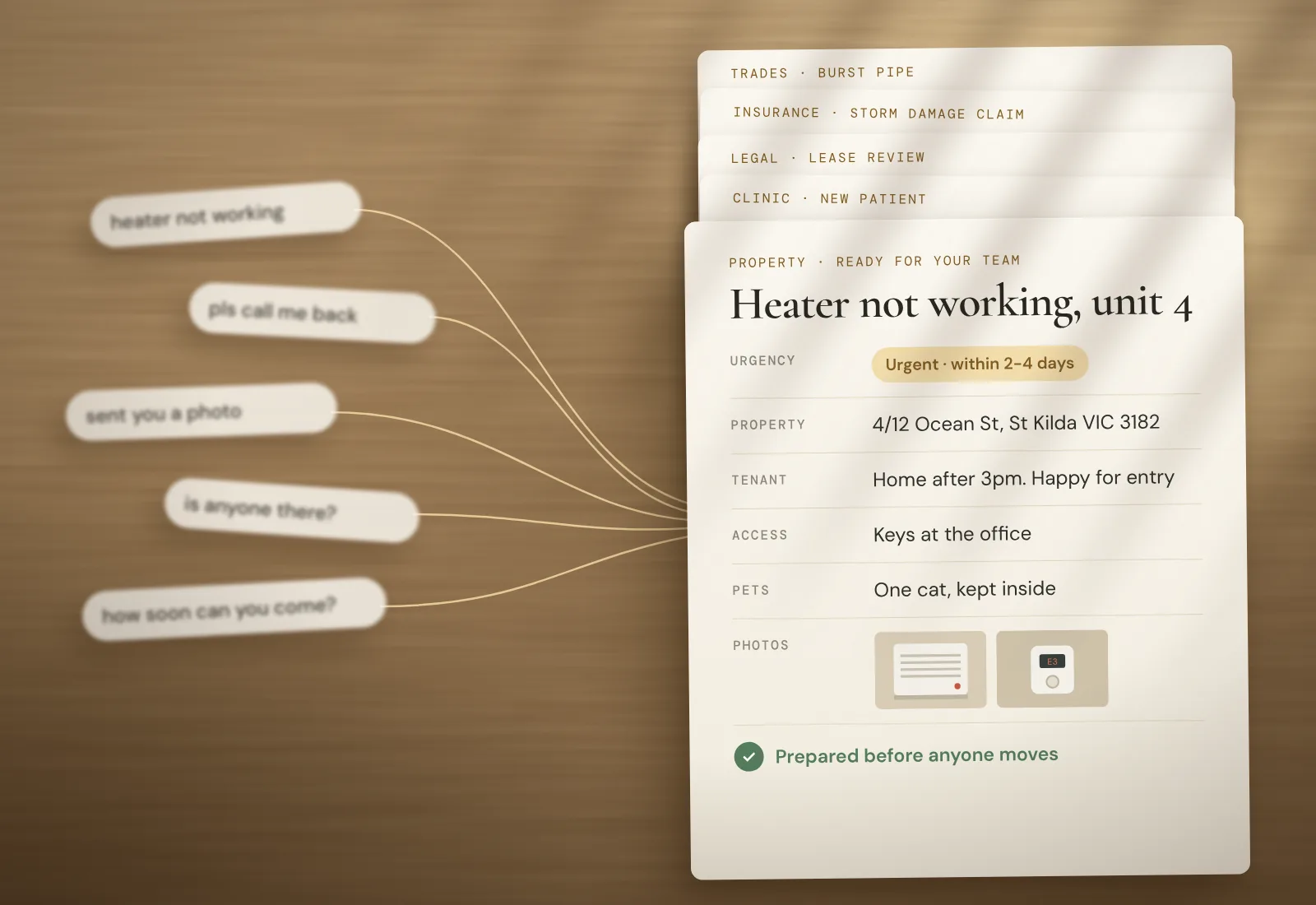
Then your team gets one clear brief: who, what, where and when, with the photos. It goes straight into your CRM, and I can suggest a time from your calendar.

With Hermia Notes, customers can ask me anything, and I answer from what your team tells me, in your words.

With Hermia Automate, your team sends me a voice note, a photo or a PDF, and every detail lands in the right place in your CRM. No typing.

Add what you need: missed calls answered on WhatsApp, booking reminders, quote and payment follow-ups, and a check-in after every job.

Your people stay in charge of every decision. They just stop chasing information. Because good work starts with the whole story.

Every business asks its own questions, in its own words. The questions change from industry to industry. The standard doesn’t.

See the conversation.
See what reaches your team.

Follow real examples from the first message to the finished record: what the customer was asked, what your team received, and how it reached the calendar. Choose your CRM to see it there.

Explore Hermia in action
How Hermia works

Open a card. See how it works.

From the first message a customer sends to every update your team sends in. Each card opens the full detail: what happens, and what it changes for your business.

Features
Every enquiry, step by step
Setup

You decide what a complete enquiry looks like

Your channels, your questions and who hears about each job, all set before Hermia speaks to a customer.

Setup

Set up for you. Checked every day.

Your settings are yours alone, and the system that runs your conversations is checked every day.

Intake

Every channel. One front door.

Email, marketplace and social messages, all handled the same careful way.

Intake

One customer. One record.

The same enquiry sent twice becomes one job, not two.

Conversation

A reply before they call someone else

Answered in about a minute, day or night, in your business’s name.

Conversation

The right questions, asked properly

Your questions, in your words, one at a time.

Accuracy

Nothing guessed. Nothing invented.

Every answer is checked before it counts, and every message before it is sent.

Accuracy

Photos that belong to the job

Every image checked before it reaches your team.

Conversation

One follow-up. Never a nag.

If a customer goes quiet, one polite reminder at a sensible hour.

Handover

A brief your team can act on

Into your CRM and your team’s inbox, ready to schedule.

Your CRM

Your CRM, complete and up to date

Clean records going in, and kept up to date as the work happens.

Bookings · Simpro, Google or Outlook

Bookings your way

Times from the right calendar. Your team confirms each one, or Hermia books it automatically.

Reliability

Busy days don’t drop enquiries

Built to carry a rush without losing a single one.

Calls · Optional feature

A missed call becomes a conversation

A WhatsApp message back within a few minutes, before they ring someone else.

Trust

What Hermia will never do

Clear lines, so your team stays in charge.

The difference

Hermia prepares the work; your people decide. A qualified person remains responsible for every assessment, every piece of professional advice, every final price and every licensed or regulated task.

Photos and illustrations show example businesses. Names, addresses and details are fictional.

Feature · Hermia Notes

Your customers ask. Hermia answers from your notes.

Hermia always asks your customers the questions your team needs answered. Hermia Notes adds the other half: it answers the questions your customers ask, such as do you cover my area, is there parking, what does it include, is it still available. The answers come only from what your team tells it.

Your words. Nothing invented.

Why it matters to your business

Every question your team answers twice is time not spent on paid work. Every question left waiting is a customer who may go elsewhere. Notes answers the common ones straight away and sends the rest to the person who knows.

Turn on Hermia Notes

Owners sign in with the email they signed up with. Your team joins by invite and can add notes on WhatsApp, or on the Notes page on any phone or laptop.

An optional feature, with its own setup fee and monthly fee: see prices. Also see Hermia Automate.

How it works

  1. Your team tells Hermia what customers need to know, the way they would tell a new colleague: “Saturday inspections now start at 10am.” “Gutter cleaning is paused until March.” “The function room is booked out in December.” A photo of a price board, a brochure, a PDF or a voice note works too.
  2. Hermia reads it and shows the person what it understood, so nothing is saved that they didn’t mean.
  3. Each note has two parts: what customers may be told, and what stays with your team. Only the first part is ever used in an answer.
  4. When a customer asks a question, Hermia answers it from those notes, in plain words, on the same channel they wrote on.
  5. Every answer is checked twice before it is sent: that every number, date and amount matches your note exactly, and that the answer says nothing your notes don’t.
  6. If the notes don’t cover the question, Hermia tells the customer it is checking with the team and asks the person who owns that topic. Their reply goes to the customer word for word, and Hermia offers to remember it for next time.
  7. Each person sees and edits their own notes. Owners and admins see the whole team’s.

What it changes for your business

  • Fewer interruptions.The questions your office answers ten times a day are answered without anyone picking up the phone.
  • Answers after hours.A question at 9pm is answered at 9pm, from the same notes your team would use.
  • One version of the truth.When something changes, one note updates every answer from that moment on.
  • Clear limits.For trades, prices, quotes, safety calls and how to fix anything are never answered by Hermia. Those questions go to you, and your answer is passed on.

Example

“Is there parking?” arrives at 8:40pm. Your notes say there are two visitor spaces behind the building. The customer has that answer within a minute, and the question and answer are saved with their enquiry for your team to see.
Feature · Hermia Automate

Everyday CRM updates, done for you.

New enquiries are only part of what goes into your CRM. Every day there’s more to record: a supplier invoice, new equipment, new item codes, a payment that came in, a customer’s new details. Hermia Automate takes a voice note, photo or PDF and puts each detail in the part of your CRM you choose, so nobody has to type it in.

Said once. Filed properly.

Why it matters to your business

Typing invoices, equipment and codes into a CRM is slow, easy to put off and easy to get wrong. When each update goes in as it arrives, your records are complete and your whole team works from the same information.

Turn on Hermia Automate

Owners sign in with the email they signed up with, choose where each kind of update goes, and invite the team.

An optional feature, with its own setup fee and monthly fee: see prices. Also see Hermia Notes.

How it works

  1. You choose where each kind of update goes: the part of your CRM and the heading. For example, supplier invoices under purchases, new equipment under assets, new codes in your price list, and changes to a customer on that customer.
  2. Your team sends Hermia a voice note, a photo or a PDF, on WhatsApp or from the Hermia page on any phone or laptop: “This week’s produce invoice, paid today.” “Signed form for 9 Elm Ave.” “New unit for the Smith Street site, serial plate attached.”
  3. Hermia reads it and picks out each detail: what it is, amounts, quantities, dates, codes, serial numbers and who it’s about.
  4. Each detail goes where you chose. You decide how: shown to the person first for a quick check, or straight in. Straight in is only used when Hermia is sure of the right record; otherwise it is shown first.
  5. Every word and number comes from what was sent. Nothing is added, guessed or reworded. A filed update can be undone for ten minutes.
  6. Hermia already looks after new enquiries from the first message. Automate is for everything else your CRM needs to know.
  7. On Simpro, Hermia writes it straight in, and a photo of a serial plate becomes the asset on the site. On any other system, each update arrives by email, laid out under your headings and ready to add.

What it changes for your business

  • No more typing it in.An update goes in when it arrives, in the time it takes to say it or take a photo.
  • Records you can trust.Equipment, codes, payments and notes are recorded the same way every time.
  • Nothing left in an inbox.A PDF in someone’s email becomes part of your records instead of waiting to be typed up.
  • Records stay yours.Healthcare businesses don’t use Automate: patient details stay in your practice system.

Examples

A café sends a photo of this week’s produce invoice: a minute later it’s under Purchases with the supplier, the amount and the date. A property manager sends a signed form: it goes on the property with the date it was signed. A plumber sends a photo of a new unit’s serial plate: it’s under Assets on the right site. Nobody types any of it in.

Setup

You decide what a complete enquiry looks like.

No two businesses define a ready job the same way. Before Hermia speaks to a single customer, you tell it what a complete enquiry looks like for you.

Your standard, not ours.

Why it matters to your business

A generic checklist produces generic jobs. When the questions come from your business, the brief that arrives already matches the way your team works. The office stops translating and starts scheduling.

What you set

  1. The channels your enquiries arrive on, and the channel your customers are answered on.
  2. Your industry or trade, so the standard questions match the work you actually do.
  3. Your own questions, up to 35, in your own words.
  4. How the next step works: an estimate drawn from your own price list, or a simple yes or no confirmation.
  5. Who is told when a lead is ready, by email.
  6. You review your whole setup on one page before anything goes live.

What it changes for your business

  • Briefs in your language.The answers arrive under your own questions, in the order your team reads them.
  • Changes when you need them.Questions can be changed later: once you’re live, that’s a USD 500 change request. Conversations already under way carry on without a hitch.
Setup

Set up for you. Checked every day.

Your questions, your wording, your recipients and your CRM connection are kept for your business alone. Every enquiry belongs to your business from its first message.

Nothing mixed. Nothing left unwatched.

Why it matters to your business

Your customers’ details never cross into another business’s records, and a problem is found by our team, not by your customers.

What happens

  1. When you save your configuration, Hermia is set up with your questions, your wording and the people who should hear about each job.
  2. You receive your customer ID, the reference you use for any change you ask for later.
  3. Every enquiry is tied to your business from its first message, and every record, note and answer stays with it. A customer of two businesses is never mixed between them.
  4. The system that runs your conversations is checked every day. If anything is off, our team is alerted and puts it right before it affects your enquiries.
  5. Each step of a job your office sends to the team is kept in a permanent record that can’t be changed afterwards, so you can always see what happened and when.
Intake

Every channel. One front door.

Customers choose where they write. Your business shouldn’t have to watch five inboxes to find the work.

Every channel meets the same standard.

Why it matters to your business

Your team sees work that belongs to them, with the person who needs help at the centre, not a pile of notifications to sort through.

What happens

  1. Enquiries arrive from email, including marketplace notifications, and from Facebook, Instagram and TikTok messages. Missed calls can be added as an optional feature. Lead forms on Facebook, Instagram, LinkedIn and Google Ads are coming soon.
  2. Genuine requests for help are separated from receipts, newsletters, supplier mail and everything else that isn’t work.
  3. The real customer is found behind the message, even when the enquiry was forwarded by a property manager or sent through a platform.
  4. The location and the kind of work are checked against your service area and what your business does before the enquiry goes any further.
Intake

One customer. One record.

The same enquiry often arrives twice: a form submitted again, an email forwarded, a customer who writes on two channels. Hermia makes sure it becomes one job.

One story per customer.

Why it matters to your business

No double bookings, no two people quoting the same job, no customer asked the same question twice. Your records stay clean without anyone tidying them.

What happens

  1. An identical enquiry arriving again is recognised and set aside before anything else happens.
  2. The first message to a customer is sent once, never twice, even if the same enquiry is delivered again.
  3. A customer who writes again in the middle of a conversation stays in that same conversation.
  4. Answers sent in pieces (a sentence, another sentence, then a photo) are gathered into one before Hermia replies.
  5. A returning customer with a new job is welcomed back, and the new job becomes its own enquiry with its own record, linked to the customer you already have.
Conversation

A reply before they call someone else.

The first business to respond clearly is usually the one that gets the job. Hermia replies on the customer’s own channel, as the assistant for your business.

No enquiry waits for business hours.

Why it matters to your business

An enquiry that arrives at 9pm is answered at 9pm. Your team keeps working, and the customer knows they have been heard before they think of calling anyone else.

What happens

  1. Within about a minute, the customer hears from Hermia, introduced as the digital assistant for your business.
  2. The first question is the one that matters most: how urgent is it? Emergency: needs assistance today, Urgent: within 2 to 4 days or Standard: this week is fine.
  3. If the customer’s number can’t receive WhatsApp, the same first message reaches them by email, with the same choices one tap away. SMS isn’t available yet.
  4. Customers can write, and be answered, in their own language. Your team reads everything in English.
  5. Every customer can reply STOP to opt out at any time.
Conversation

The right questions, asked properly.

Hermia asks what your team needs to know: the standard questions for your kind of work, then your own. One at a time, in plain language.

One question at a time, until it’s answered.

Why it matters to your business

Your team stops making the call it always makes (“what’s the gate code?”, “when is settlement?”) because the question was asked and answered before anyone picked up the phone.

What happens

  1. Every enquiry starts with how urgent it is. For trades, the standard questions follow: the problem, the site, access, safety, timing and who is paying.
  2. Your own questions follow, in the order you set.
  3. Each new question is reviewed once when you add it. Spelling and grammar are tidied without changing the meaning, and a question too vague to answer is flagged to you.
  4. If an answer can’t be used, the question is asked again with an example of a good answer.
  5. Voice messages and videos are written out as text, so a customer can answer however suits them.
  6. You can change your questions whenever you need to (once you’re live, a USD 500 change request). The change applies from the customer’s next reply.
Accuracy

Nothing guessed. Nothing invented.

Hermia’s tone is warm, but its standard does not move. An answer counts only when it genuinely answers the question.

An honest gap beats a confident guess.

Why it matters to your business

Your team can trust the brief. When something is missing, the brief says so, instead of looking complete and turning out to be wrong later.

What happens

  1. Every answer is checked before it counts. If the check can’t run, a backup takes over; if no check can run, the answer waits rather than slipping through.
  2. OK is not an answer to a question that asks for a fact, and neither is a string of random letters. Both are asked again.
  3. A customer who still can’t answer after three attempts is moved on politely, and the record says exactly that: Not answered (asked 3 times). Urgency is never assumed.
  4. Every message Hermia writes is checked before it is sent: no times it can’t keep, no promises, no prices or links unless they are your own, and nothing longer than a short reply. A message that fails the check is replaced by the plain question.
  5. Nothing is filled in on the customer’s behalf. If they didn’t say it or show it, it isn’t in the brief.
Accuracy

Photos that belong to the job.

A photo can save a visit or a phone call, or waste one. Hermia checks every image the moment it arrives.

Evidence, not attachments.

Why it matters to your business

Your people see the actual problem before they act, and your staff never have to open something they shouldn’t.

What happens

  1. Photos and videos are checked against the enquiry before they are saved or passed on.
  2. Unrelated or inappropriate images never reach your team. The customer is asked, politely, for a clear photo of what they need help with.
  3. Several photos sent at once receive one reply, not several.
  4. Accepted photos and videos stay with the same job, so your team sees the problem rather than reading about it.
  5. A photo a customer sends after the job is kept on that job and passed to your office.
Conversation

One follow-up. Never a nag.

People get busy. An enquiry that goes quiet isn’t always lost. Often it only needs one reminder: It’s Hermia from your business again. Just checking in on your enquiry. Do you still need help?

Once, at the right time.

Why it matters to your business

Work that would have gone quietly cold is recovered, without making your business look desperate or pushy.

What happens

  1. If a new customer hasn’t replied after 24 hours, Hermia sends one friendly follow-up on WhatsApp.
  2. It only goes out between 9am and 7pm in your business’s own time zone. Never at midnight.
  3. It is cancelled the moment the customer replies, and never sent for an enquiry that is closed or more than three days old.
  4. There is never a second one.
Handover

A brief your team can act on.

When the conversation is complete, what arrives isn’t a chat log. It’s a prepared job.

Nothing is handed over half-finished.

Why it matters to your business

No retyping, no copying from a chat, no “what did they say about access?”. The office acts, and whoever goes next arrives prepared.

What arrives

  1. The enquiry goes straight into the system your team already works in, with the description and notes already written and every answer to your own questions on its own line.
  2. A private lead docket is emailed to the people you chose, with the answers to your questions and the photos.
  3. For trades on Simpro, your office can find the right person from the docket, confirm a time and send them the job, with the address, access details and brief on one page.
  4. System not connected yet? Every prepared enquiry still reaches you straight away as the lead docket by email. If a delivery to your system can’t be confirmed within 30 minutes, the full brief is emailed to you instead. Nothing is lost.
Your CRM

Your CRM, complete and up to date.

A CRM is only as good as what goes into it. Hermia stops the mess at the door, then keeps every record growing as the work happens.

Right before it exists. Better every day after.

Why it matters to your business

The same customer saved three times, half-empty records, notes that say “see email” or “call back??”. Nobody trusts a CRM like that, so nobody uses it properly. Hermia makes the system you already pay for worth trusting.

Before anything is saved

  1. One enquiry, one record. The same enquiry sent twice, or a customer writing on two channels, becomes one record, not three.
  2. Matched to the customer you already have. When your system already holds the customer and their site, the enquiry joins their history instead of starting a duplicate.
  3. Urgency on every record. Needed today, within days, or this week is fine, so the most urgent work is seen first.
  4. No silent blanks. If something wasn’t answered, the record says so: Not answered (asked 3 times).
  5. Photos, videos and voice, made usable. Photos are checked, then kept with the enquiry they belong to. Videos and voice messages arrive as text your team can read.

After it is saved

  • Everyday updates.With Hermia Automate, a voice note, photo or PDF goes into the part of your CRM you choose: equipment, purchases, codes or notes.
  • Customer questions kept.With Hermia Notes, “is there parking?” is answered, and the question and answer are saved with the lead.
  • Bookings written in.For trades on Simpro, the confirmed booking is written into the schedule and the customer is told the day and time.
  • Nothing lost on the way in.Every lead is saved before it is delivered. If your system can’t confirm it within 30 minutes, the full brief is emailed to you instead.

Works with what you use

Hermia writes into the system your team already works in. Not connected yet? Every prepared enquiry still reaches you straight away as a secure lead docket by email, and connecting your CRM later is one change request: nothing is rebuilt.

Bookings · Simpro, Google or Outlook

Bookings your way.

Hermia offers the time. Your team says yes, or Hermia books it for you.

Offered, then approved.

Why it matters to your business

A booking nobody agreed to is worse than no booking. Approved times are times your team will keep.

What happens

  1. Hermia finds the right person and a free time in your system, and your team confirms it. Or you choose to let Hermia book automatically.
  2. The confirmed booking is written into your schedule, and the customer is told the day and time once, on WhatsApp or by email.
  3. If a booking moves to another person or time, the customer is told once, and so is the team member.
  4. The team member can be sent the job: the day, time, address, access details and brief, with a link to add their notes after the job.
  5. Owners and admins see every booking in one list, with how each customer was told.
Reliability

Busy days don’t drop enquiries.

The day your phone runs hot is the day the system matters most. Hermia is built to slow down gracefully, never to drop work.

Slow down, never drop.

Why it matters to your business

Your busiest week (a storm, a heatwave, the end of financial year) should be your best week, not the week enquiries go missing.

What happens

  1. When a messaging channel asks Hermia to slow down, messages wait their turn and go out within minutes. They are never thrown away, and never swapped for something less suitable.
  2. Enquiries arriving in a rush are queued and handled in the order they arrived.
  3. Every check has a backup. If nothing can check an answer, the answer waits rather than slipping through unchecked.
  4. Anything that fails is tried again automatically, and our team is alerted the moment something needs a person.
Calls · Optional feature

A missed call becomes a conversation.

The phone rings while everyone is on a job. Hermia picks up the thread within a few minutes.

No caller left at voicemail.

Why it matters to your business

Most people who reach voicemail ring the next business.

What happens

  1. Calls you can’t answer go to your Hermia number, and the caller can leave a message.
  2. Hermia messages the caller back on WhatsApp within a few minutes and asks your questions, as it does with every enquiry. Your team gets the brief.
  3. If the caller can’t be reached on WhatsApp, your team is emailed to call them back, with their message written out.
  4. Missed calls is an optional feature, with its own setup fee and monthly fee. It isn’t offered to finance businesses, because Hermia never messages their customers, and isn’t offered to clinics yet.
Trust

What Hermia will never do.

Hermia prepares the work. Qualified people make the decisions. Those lines don’t blur.

Prepare the work. Never pretend to be the expert.

Why it matters to your business

Automation that oversteps creates more work than it saves. Your team can rely on Hermia precisely because it knows where to stop.

The lines we hold

  • No final prices. Estimates come only from your own price list, and anything uncertain goes to your team instead of being guessed.
  • No expert judgement. Hermia never makes safety assessments, never gives legal, medical or financial advice, and never stands in for licensed or regulated work.
  • No promises it can’t keep. It never offers a time your team hasn’t got.
  • No pretending. An unanswered question is recorded as unanswered.
  • No messages to finance customers. Finance enquiries are read and briefed for your team; Hermia never writes to the customer.
  • No taking your customer. Hermia speaks for your business, and the relationship stays yours.
  • No holding on. A customer who replies STOP is not contacted again.
The difference

What changes on day one.

Nothing to install and nothing new for your customers to learn. They contact you the way they already do. Your team starts each job knowing what it is.

Same customers. Less chasing.

Why it matters to your business

Most of the time lost in a service business is lost between people: the customer, the office, the person doing the work and the CRM. Hermia closes those gaps from the first day.

Before and after

  1. An enquiry at 9pm waits until morning.It is answered in about a minute, day or night, as your business.
  2. Someone rings back to ask the basics.Your questions are asked one at a time, and asked again when an answer can’t be used.
  3. The same customer ends up in three records.Existing customers are matched before anything new is created.
  4. Leads are forwarded around the office.Each person you choose gets their own private copy of the brief.
  5. What your business knows lives in someone’s head.It lives in Hermia Notes, and answers your customers in your words.
  6. Invoices, new equipment and codes get typed in by hand.A voice note, photo or PDF goes into your CRM, where you chose.
  7. Nobody is sure a booking was confirmed.Your team confirms the time, or Hermia books it automatically if you choose, and the customer is told once.
Get started

Know the job before your team acts.

Configure Hermia with your channels, your questions and the people who should hear about each job. You review your whole setup before anything goes live, and you can change it whenever your business changes (once you’re live, USD 500 for each kind of change).